

At the turn of the 20th and 21st centuries, programming drums for songs in genres that use acoustic drums was a quite reasonable alternative to recording drums in a regular recording studio. At that time, drum sample libraries appeared, containing several microphone recordings for each hit, which allowed for more flexible/realistic mixing of parts created with their use, comparing to drum parts programmed with ready-made sound samples.
The quality/usability of a drum-samples library depended on three factors:
- The amount of microphone takes for each element of the drum-set.
- The number of so-called dynamic layers, i.e. how many volume levels of separate hits were recorded for each element of the drum kit.
- The number of recorded versions of a hit in a given dynamic range, which is necessary for realistic sound of drum parts consisting of successive hits with the same volume on the same drum/cymbal (no so-called “machine gun” effect).
I do not expand on this topic further, although one could write a book about it. Especially since drum programming is by no means limited to acoustic drums and still covers a fairly large area in the field of modern music production.
My drum programming
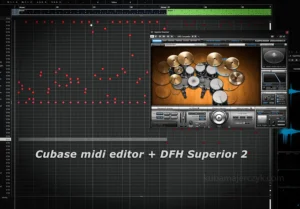 I started programming drum parts pretty much when I started using a DAW – which in my case was Cubase SX (around 2002).
At that time, the market offered, among others, “Drumkit From Hell” by Swedish company Toontrack, available since 1999 – a large set of multi-layered acoustic drum samples, allowing for the creation of fairly realistic-sounding rock-metal drum parts, as far as memory serves, already with some possibility of independent mixing of close, overhead, and room mics. However, I am not 100% sure about that last detail at this moment.
The original version of Drumkit From Hell certainly didn’t offer its own play engine – it contained presets for use in other manufacturers’ samplers of the time: LM4, NI Battery, EXS24, GigaSampler, and Halion.
BTW it might be worth mentioning that during that period I also carried out the idea of creating a set of my own drum samples for personal use – living in Wrocław at the time, thanks to the courtesy of Bartek Straburzyński and Robert Szydło, I was able to record an extensive set of samples of my Ludwig drums (80′ Chrome over wood – 24″, 14″, 18″, 14×6’5 Supraphonic Super Sensitive snare drum).
I developed these samples in a multi-layered format, with the ability to independently mix close, overhead, and room mics, for formats including Steinberg Halion and NI Kontakt. At that time, I even offered this instrument under the name Vintage Drumset on my website in those years.
In 2003, Toontrack released a new incarnation of Drumkit From Hell: DFH Superior Drummer (DFHS) – an independent virtual instrument offering, let’s say, raw, multilayered samples of acoustic drums and percussion instruments. At the time, DFHS had no competition, considering its ability to create realistic-sounding, multi-track drum parts, including microphone bleeding.
DFHS then became my main tool for creating programmed acoustic drum parts.
Toontrack Competition 2005 – drum programming contest
In 2005, I entered a competition announced by Toontrack.
The goal was to deliver a song that used a drum part programmed in DFHS. So I created a simple groove in 5/4 in MIDI, added some riffs and, of course, a drum solo. I also used most of the percussion instruments from the set in the arrangement. My friend, the amazing Piotr “Wino” Winnicki, recorded cool guitars here, I made the bass from samples (EW Hardcore Bass library), mixed everything in Cubase SX 2, sent in my entry, and forgot about it.
After some time, one evening I thought about the contest, checked the Tontrack website, and got a nice surprise – it turned out that my piece had officially won in the “Superior Drummer programming” category.
The original mix submitted to the competition in 2005, however remastered by me in 2024, can be listened to below: